Why You'll Love It
- - Easy to follow steps for beginners
- - Minimal ingredients, maximum flavor
- - Versatile fillings for any season
- - Satisfying sense of achievement
"These macarons turned out so perfect, even my teenage kids were impressed!"
Essential Ingredient Guide
- Almond flour: Choose a fine, sifted almond flour for a smooth shell; it gives the classic nutty fragrance.
- Powdered sugar: Sifted powdered sugar ensures no gritty texture and helps the meringue hold its shape.
- Egg whites: Use room‑temperature whites, whisked to stiff peaks for shiny, glossy shells.
- Granulated sugar: Adds stability to the meringue and a subtle sweetness.
- Food‑grade coloring: A few drops give a gentle hue—optional but lovely for visual appeal.
- Buttercream or ganache filling: Choose a silky buttercream, perhaps a vanilla bean, or a dark chocolate ganache for contrast.
Complete Cooking Process
-
Ingredient Readiness:
Sift almond flour and powdered sugar together; let egg whites sit out for 30 minutes.
-
Flavor Development:
Whisk the meringue until glossy; gently fold the dry mix to create the macaronage.
-
Texture Control:
Pipe uniform circles and allow them to rest until a skin forms—this prevents cracks.
-
Finishing Touches:
After baking, pair shells with your chosen filling and let them rest for a few hours.
-
Serving Timing:
Macarons taste best after 24 hours, when flavors have melded together.
- Measure egg whites by weight for consistency
- Do not over‑mix; the batter should flow like lava
- Use a silicone mat for even heat distribution
- Let shells rest 30‑60 min before baking
Pro Tips
I’ve found that a quiet kitchen, with a soft hum of the oven, makes the whole process feel ritualistic. It’s okay if the first batch isn’t perfect—each attempt teaches you a little more about the delicate balance of moisture and air.
The essence of the dish:
A fun fact or historical angle:
Flavor or sensory focus:
You Must Know
- Resting time is crucial
- Even piping size matters
- Oven temperature must be steady
Frequently Asked Questions
→ Can I use food coloring?
Yes, a few drops of gel or powder coloring will give a gentle hue without altering the batter consistency.
→ Why do my shells crack?
Cracking often means the shells didn’t rest long enough or the oven temperature was too high.
→ How long can I store them?
Stored in an airtight container in the fridge for up to a week; bring to room temperature before serving.
→ Can I freeze macarons?
Yes—freeze in a single layer, then transfer to a zip bag; thaw slowly for best texture.
→ What fillings work best?
Classic buttercream, ganache, fruit curds, or even a light mousse complement the shells.
→ Do I need a piping bag?
A reusable silicone bag works well, but a sturdy zip‑top bag with a corner cut off can suffice.
Chef's Tips
If the shells crack, try a lower oven temperature next time.,For a richer filling, substitute half the butter with cream cheese.,Allow the assembled macarons to rest in the fridge for at least 12 hours for optimal flavor melding.
Nutrition Facts
per serving
120
Calories
2g
Protein
15g
Carbs
6g
Fat
Taste Profile
A gentle sweet almond flavor with creamy richness from the filling.
Ingredient Substitutions
Don't have an ingredient? Try these alternatives
Will give a deeper nutty flavor; sift well.
Will affect richness; use a high‑quality variety.
Recipe Variations
Try these delicious twists on the original
Spicy Version
Add a pinch of cayenne and chocolate ganache for a subtle kick.
Mediterranean Style
Fold finely chopped pistachios into the shell batter and fill with honey‑lavender buttercream.
Common Mistakes to Avoid
Learn from others' mistakes for perfect results
- Over‑mixing the batter, leading to flat shells
- Skipping the resting period, causing cracks
- Baking at too high a temperature, resulting in burnt edges
Meal Prep & Storage
Make Ahead Tips
You can pipe and rest the shells a day ahead; store them unbaked in an airtight container and bake when ready.
Leftover Ideas
Store assembled macarons in the fridge; let them sit at room temperature 15 minutes before serving.
Perfect Pairings
Serve this with...
Cooking Timeline
Prep dry ingredients and separate egg whites.
Whisk meringue to stiff peaks; add coloring if desired.
Fold dry mixture into meringue creating macaronage.
Pipe shells and let them rest until skin forms.
Bake shells, cool, then pipe and sandwich fillings.
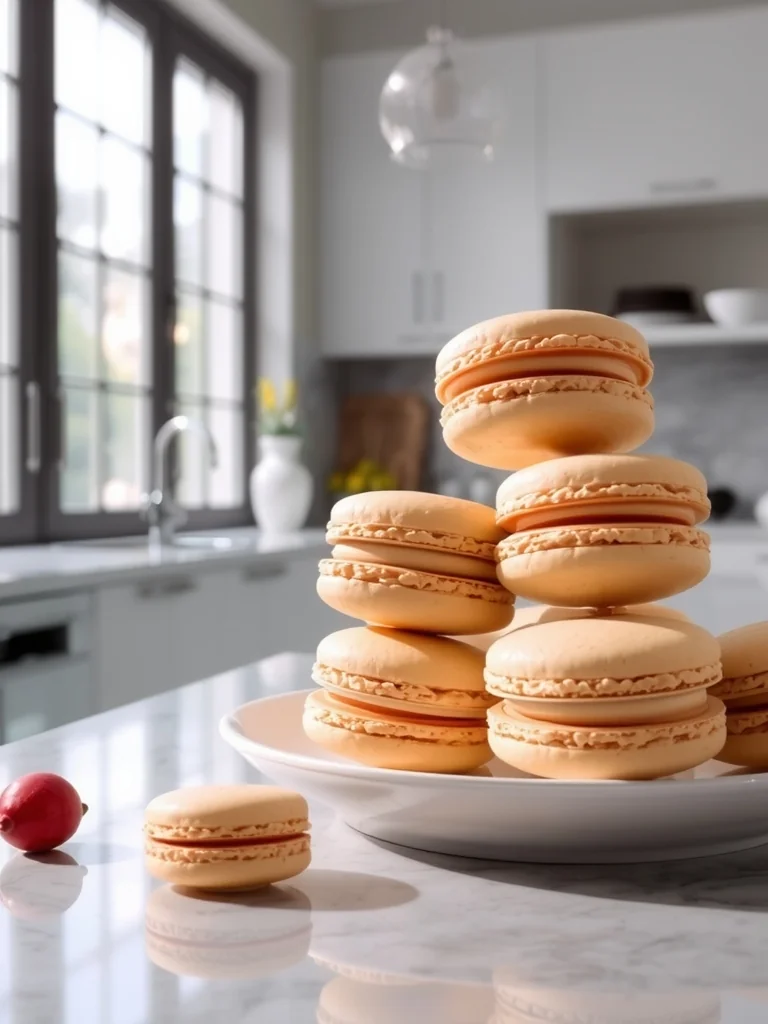
French Macarons
Learn how to make classic French macarons with this beginner‑friendly recipe—crisp shells, chewy centers, perfect for any occasion.
Timing
Prep Time
30 Minutes
Cook Time
20 Minutes
Total Time
1 Hour 30 Minutes
Recipe Details
Ingredients
Shells
- 01 150 g almond flour
- 02 150 g powdered sugar
- 03 100 g granulated sugar
- 04 90 g egg whites (about 3 large eggs), at room temperature
- 05 Pinch of salt
- 06 Food‑grade coloring (optional)
Filling
- 01 100 g unsalted butter, softened
- 02 80 g powdered sugar
- 03 1 tsp vanilla extract
- 04 30 g heavy cream
Instructions
Sift the almond flour and powdered sugar together into a bowl; set aside.
In a clean bowl, whisk the egg whites with a pinch of salt until foamy, then gradually add the granulated sugar while whisking on medium speed.
Increase to high speed and whisk until stiff, glossy peaks form; add a few drops of coloring if desired.
Fold the dry mixture into the meringue gently, 3‑4 times, until the batter flows like lava and forms a smooth ribbon.
Transfer the batter to a piping bag fitted with a ½‑inch round tip; pipe 1‑inch circles onto a silicone mat.
Let the piped shells rest at room temperature for 30‑60 minutes, until a skin forms and they no longer stick to your fingertip.
Preheat the oven to 300°F (150°C). Bake the shells for 15‑18 minutes, rotating halfway through.
Cool completely, then pair similar‑sized shells; pipe a dollop of buttercream onto a bottom shell and sandwich with the top.
Notes & Tips
- 1 If the shells crack, try a lower oven temperature next time.
- 2 For a richer filling, substitute half the butter with cream cheese.
- 3 Allow the assembled macarons to rest in the fridge for at least 12 hours for optimal flavor melding.
Tools You'll Need
-
Silicone baking mat
-
Sieve
-
Electric mixer
-
Rubber spatula
-
Piping bag
-
Round piping tip
Must-Know Tips
- Don’t over‑mix; aim for a smooth ribbon consistency.
- Rest the shells until the surface is dry to the touch.
- Use a kitchen scale for accurate measurements.
Professional Secrets
- Room temperature egg whites whisk evenly, ensuring uniform bubbles.
- A steady low oven temperature prevents over‑browning.
- Leaving the shells to mature enhances the delicate interior texture.

Recipe by
EvaEva is a seasoned home‑cook turned recipe developer who brings a dash of curiosity and a pinch of precision to every dish she creates for Your Website ...
Get Delicious Recipes Weekly
Join 25,000+ home cooks getting our best recipes straight to their inbox.
Free forever • No spam • Unsubscribe anytime